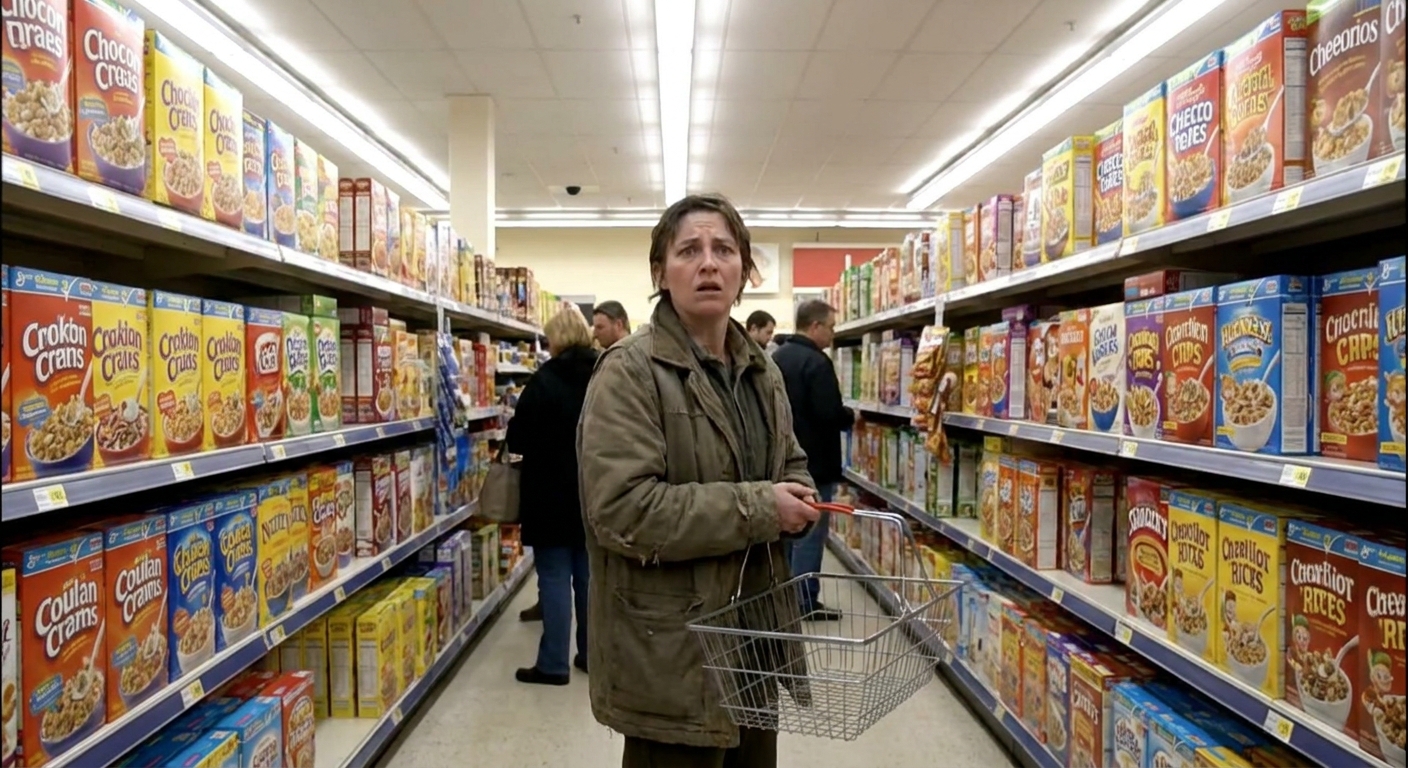
Walk into a modern supermarket and you can face over 150 types of cereal, dozens of olive oils, and an entire wall of yogurt. Technically, this is freedom.
Choice Overload: Why More Options Make Us Miserable (And How to Decide Anyway)
Psychologically, it can feel like a trap.
The assumption of modern life is that more choice = better outcomes = more happiness. Decision research paints a more complicated picture: beyond a certain point, additional options can:
- Freeze us into indecision
- Worsen our satisfaction, even when we choose well
- Increase our regret and self-blame
This phenomenon is known as choice overload or the paradox of choice.
Let’s look at the science behind it, when it actually applies, and how to navigate rich choice environments without burning out your frontal lobes.
The Jam Experiment That Launched a Thousand Articles
In a now-classic 2000 study, Sheena Iyengar and Mark Lepper set up a jam-tasting booth in a California grocery store.
On some days, shoppers saw a table with 24 jams. On others, they saw a table with 6 jams.
Here’s what happened:
- The 24-jam table attracted more people to stop and sample.
- But when it came to purchasing, only about 3% of those who sampled from the large assortment bought a jar.
- In contrast, around 30% of those who sampled from the 6-jam table made a purchase.
Fewer options led to more action.
This study sparked the idea that very large assortments can be demotivating, not liberating. Follow-up work has shown similar patterns in retirement plans, online dating, and even Netflix queues.
However — and this is important — subsequent large-scale analyses (e.g., by Scheibehenne, Greifeneder, and Todd in 2010) found that choice overload effects are real but context-dependent, not universal.
So the key question becomes: when do many choices help, and when do they hurt?
When More Choice Helps vs. When It Hurts
When More Options Are Good
- You have strong, stable preferences.
- If you know you love smoky single-origin coffee, more options let you find closer matches.
- The cost of a mistake is low.
- Trying a new playlist or snack? Extra options are mostly fun.
- You have good filtering tools.
- Search functions, reviews, and smart recommendations reduce cognitive load.
- You enjoy exploration.
- Some people genuinely like browsing and comparing — exploration is part of the reward.
When More Options Hurt
Choice overload tends to bite when:
- The decision is important and complex.
- Retirement plans, healthcare options, degree programs.
- You lack clear preferences or expertise.
- First-time home buyer facing dozens of mortgages.
- Options are difficult to compare.
- Abstract trade-offs (e.g., future flexibility vs. current salary).
- The consequences feel personal.
- When the outcome reflects on your identity or competence, you’re more prone to regret.
In such situations, you may find yourself scrolling endlessly, revisiting the same options, or delaying indefinitely.
The Psychology Under the Overwhelm
Why do extra options sometimes make our lives harder?
1. Cognitive Load: The Brain Has Bandwidth Limits
Comparing many attributes across many alternatives taxes working memory and executive function. The prefrontal cortex, responsible for weighing pros and cons, has limited capacity.
As options multiply, your brain starts using shortcuts — focusing on salient but not necessarily important features (price, brand, first impressions), or defaulting to inaction.
2. Counterfactual Explosion: So Many “What Ifs”
Every option not chosen becomes a counterfactual — an imagined alternative life.
With a few options, there are a few what-ifs. With dozens, the unchosen possibilities can feel infinite.
Research on regret shows that people are more likely to:
- Ruminate about near-miss options (“I almost picked that other one…”).
- Overestimate how good unchosen options would have been.
3. Responsibility and Self-Blame
When you only have one or two options, it’s easy to blame circumstance if things go wrong.
When you had hundreds of potential matches, products, or careers, it’s easy to think:
“If I’m unhappy, it’s because I chose badly.”
Barry Schwartz, who popularized the paradox of choice, argues that this increased self-responsibility can undercut satisfaction, even when objective outcomes are good.
4. Shifting Standards: From “Good Enough” to “Optimal”
Abundant choice nudges us from a satisficing mindset (seeking “good enough”) toward an optimizing mindset (seeking the best).
Ironically, optimizers often:
- Make slightly better decisions on paper.
- Feel less satisfied with them.
In a 2006 study, Schwartz and colleagues found that high “maximizers” reported more regret, more depression, and lower life satisfaction, even when their objective achievements were superior.
Two Decision Styles: Satisficers vs. Maximizers
Understanding your own decision style is one of the most actionable insights in this area.
Satisficers
- Set clear minimum criteria.
- Stop searching once they find an option that meets their standards.
- Feel comfortable with “good enough.”
Maximizers
- Aim to survey the field and find the best possible option.
- Keep searching even after finding good candidates.
- Are more prone to comparison, regret, and second-guessing.
Research doesn’t say “never maximize,” but it does suggest that chronically maximizing in domains with infinite options and fuzzy outcomes (careers, relationships, lifestyle) can be psychologically costly.
Practical Strategies: How to Decide in an Over-Choice World
1. Decide How You’ll Decide (Meta-Decisions)
Before wading into the pool of options, clarify your decision process:
- Will you satisfice or maximize for this decision?
- What’s your time budget? (e.g., “I’ll research for 2 hours, then choose.”)
- What information is must-have vs. nice-to-have?
Meta-decisions reduce the slippery feeling that the search could go on forever.
2. Set Explicit Criteria First
Write down 3–5 non-negotiable criteria before you look at options.
For example, choosing a new apartment:
- Commute under 45 minutes.
- Rent less than $1,800.
- Safe neighborhood.
- Natural light.
Everything else (flooring, appliances, decor) is secondary.
This simple move transforms an unbounded search into a filtering exercise.
3. Limit Your Search Set Intentionally
Impose artificial boundaries:
- “I will shortlist 5 options and choose from those.”
- “I will visit 3 dealerships, not 12.”
Research on satisficing suggests that beyond a modest number of options, extra searching yields diminishing returns but more stress.
4. Use Tiers: Explore, Then Exploit
Borrow a concept from reinforcement learning:
- Explore phase: Sample a small number of varied options (e.g., 5–10).
- Exploit phase: Choose the best among them, without returning to the wider universe.
For example, if you’re choosing a therapist:
- Do brief intro calls with 4–5.
- Pick the one that best matches your core criteria.
- Commit to trying for 4–6 sessions before reconsidering.
5. Pre-Commit to “Good Enough” in Certain Domains
Not every decision deserves optimization. Decide in advance where you’ll allow yourself to be a satisficer:
- Clothes: one or two favorite brands, minimal comparison.
- Daily lunches: a small rotation, not endless novelty.
- Streaming content: use curated lists or a trusted recommender.
You free up cognitive resources for decisions that genuinely need fine-grained evaluation.
6. Practice Post-Decision Closure
Once you’ve decided:
- Stop researching the category.
- Avoid “just checking” for better deals.
- If you catch yourself comparing, gently remind yourself: “That search phase is done; now I’m in the experience phase.”
This is not self-deception; it’s a recognition that ongoing comparison erodes satisfaction without changing the past.
7. Use Regret as Data, Not Punishment
When you do regret a choice, skip the global self-criticism. Instead ask:
- Was my process reasonable, given what I knew then?
- What signal did I miss or overweight?
- Is this a domain where I should impose tighter constraints next time?
Turn regret into an update to your decision playbook, not a judgment on your competence.
A Short Exercise: Taming One Overloaded Decision
Think of a decision where you feel stuck in option paralysis right now (a course, job, product, or trip).
- Write your non-negotiables. 3–5 criteria.
- Set a search cap. How many options will you seriously consider? (Aim for 5–10, not 50.)
- Give yourself a deadline. “By [date], I will choose.”
- Plan a review point. “In 3 months, I’ll check in and adjust if needed.”
You haven’t removed uncertainty. You have reined in unbounded choice — and that’s often enough to move forward.
The Paradox Resolved: Freedom With Boundaries
Choice overload doesn’t mean we should wish for fewer options or go back to a three-channel television universe.
It means that freedom requires structure.
Your brain was not built for infinite scroll. It was built for adequate options, clear feedback, and reasonable stakes.
In a world that endlessly expands the menu, wisdom lies not in scanning everything, but in learning to say:
“Here is what matters. Here is enough. I choose, and then I live that choice.”