Most of us like to believe we’d help in an emergency. Yet real life, and decades of social psychology, tell a more complicated story.
Why Good People Sometimes Do Nothing
People freeze. They look around. They wait.
Not because they’re bad, but because powerful social forces quietly shape their behavior. The bystander effect is one of the most unsettling—and practically useful—findings in social psychology.
This guide will walk through the science of why people fail to act, the myths around courage, and concrete steps you can use to move from bystander to upstander when it matters.
The Origins: A Tragedy and a Question
In 1964, Kitty Genovese was murdered outside her apartment building in New York. Early news reports (later found to be exaggerated) suggested that dozens of neighbors watched and did nothing.
Social psychologists Bibb Latané and John Darley were deeply troubled by this story. Rather than accepting “people are apathetic” as an answer, they asked a more precise question:
Under what conditions do people fail to help—and why?
Their series of laboratory and field experiments revealed that context, not character, often decides whether help arrives.
The Bystander Effect: More People, Less Help
In a landmark 1968 study, Latané and Darley placed participants in individual cubicles, connected only by intercom to what they believed were other participants.
During the session, they heard someone (actually a recording) seemingly have a seizure, gasping and calling for help.
Results:
- Believing they were the only one who could help, 85% of participants intervened.
- Believing two others were present dropped helping to about 62%.
- Believing four others could hear the person lowered helping to 31%.
The more bystanders, the less likely any one person was to act.
This isn’t just a lab curiosity. Real-world studies of emergencies, bullying, and workplace harassment show similar patterns: diffusion of responsibility and social influence paralyze action.
The Five Steps to Helping (and Where We Get Stuck)
Latané and Darley proposed a now-classic model of how people move from noticing a problem to actually helping. At each step, we can get derailed.
Step 1: Notice the Event
You can’t help if you don’t recognize that something is happening.
- Urban environments bombard us with sights and sounds; we often tune out.
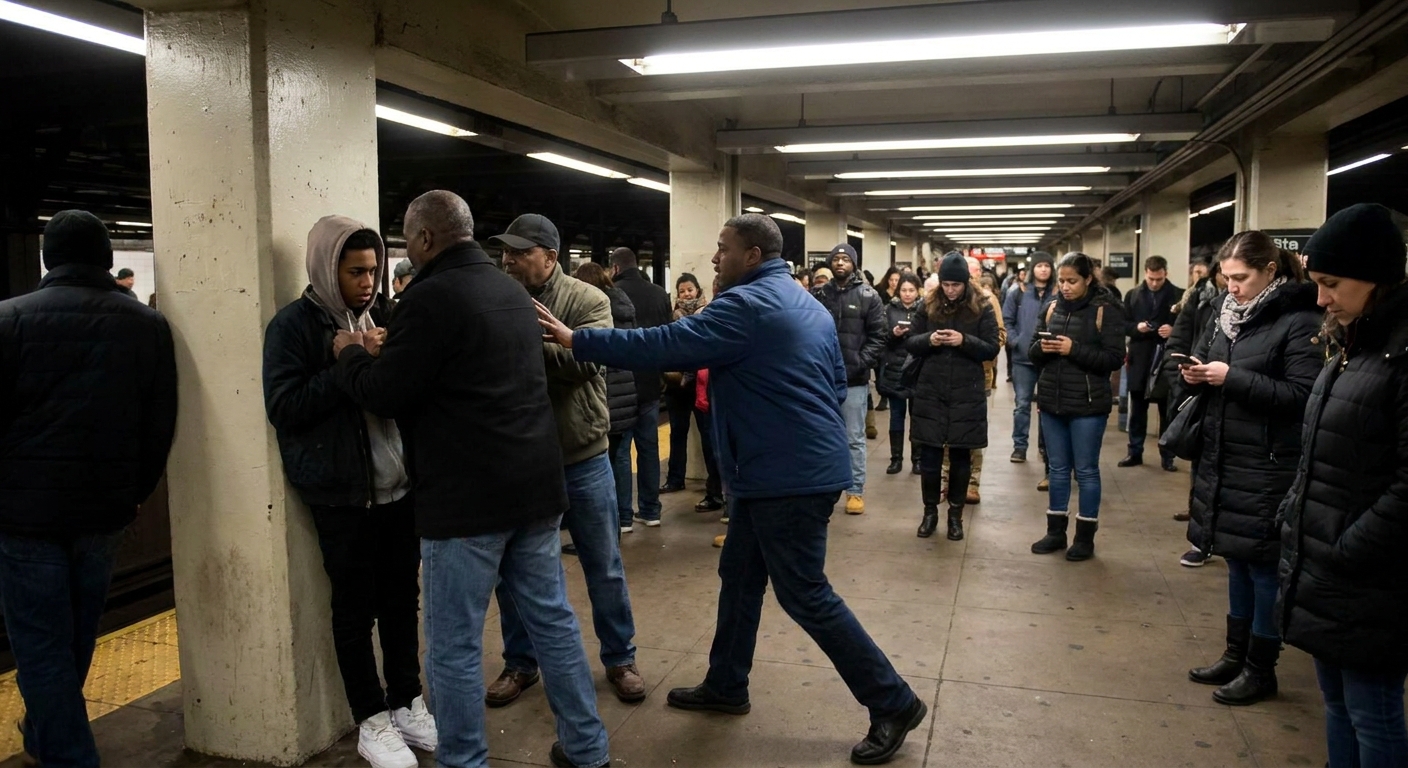
- Phones and headphones narrow our attention further.
Intervention point: Train your attention. Periodically look up, scan your environment, and ask, “Does anyone here seem like they might need something?”
Step 2: Interpret It as an Emergency
Ambiguity is the enemy of action.
In one experiment, participants heard a loud crash and a person crying out in pain. When alone, 70% investigated. When with passive confederates who ignored the noise, only 7% did.
This is pluralistic ignorance: everyone is privately unsure but publicly calm, so each person takes others’ inaction as a sign that everything is fine.
Intervention point: Trust your concern. If something feels off, assume it might be real—even if others look unconcerned.
Step 3: Take Responsibility
When many people are present, helping can feel like someone else’s job.
This diffusion of responsibility is subtle. You may feel a vague unease instead of a clear sense of duty.
Intervention point: Consciously claim responsibility. Mentally say, “If I don’t do something, maybe no one will.”
Step 4: Decide How to Help
Even if you want to help, you might feel unqualified or unsure.
- “I’m not a doctor.”
- “What if I make it worse?”
- “What if I misread the situation and embarrass myself?”
Intervention point: Remember that even small actions—calling emergency services, alerting staff, asking “Are you okay?”—can be crucial.
Step 5: Implement the Decision
Finally, you must act, despite fear or social risk.
This is where practical scripts and habits matter most.
The Social Psychology of Courage: It’s Less Heroic Than You Think
We tend to imagine helpers as unusually brave individuals. Research suggests a more grounded truth:
People who help often see their actions as ordinary, even inevitable.
Several factors predict helping behavior:
- Perceived similarity: We’re more likely to help those we see as “like us.”
- Role models: Seeing others help makes us more likely to do so.
- Past behavior: Having helped before increases future helping—helping becomes part of one’s identity.
In one study, people who had just found a dime in a phone booth (a tiny mood boost) were dramatically more likely to help a stranger pick up dropped papers.
This suggests that small shifts in context and mindset can have big effects.
How to Become an Upstander: Concrete Strategies
1. Pre-Commit: Decide Your Values in Advance
In the moment, you won’t have time for a philosophical debate with yourself. So decide now:
- “If I see someone being harassed, I will not pretend I didn’t see it.”
- “If I think someone might be in danger, I will at least check in or call for help.”
This turns action from a surprising exception into a default setting.
2. Use the “Direct, Distract, Delegate” Framework
This widely taught bystander intervention model gives you flexible options.
- Direct: Address the situation.
- “Hey, is everything okay here?”
- “That comment isn’t appropriate.”
- Distract: Disrupt without confronting directly.
- Spill a drink, ask for directions, start an unrelated conversation.
- “Hey, I think your car lights are on.”
- Delegate: Get help from someone with more authority or capacity.
- Call emergency services.
- Alert security, staff, or a supervisor.
Choose the approach that feels safest and most realistic for you.
3. Break Pluralistic Ignorance Out Loud
In ambiguous situations, people often wait for a cue. You can provide that cue.
Phrases like:
- “I’m worried about this—does anyone else see that?”
- “This doesn’t seem right to me.”
signal that it’s okay to treat the situation as serious. You’re helping others move from step 2 (interpretation) to step 3 (responsibility).
4. Assign Responsibility Clearly
In a crowd, vague requests often fail. Instead of shouting, “Somebody call 911!”, try:
- Point at a specific person: “You in the blue jacket—can you call emergency services?”
- “You, with the backpack—can you help me clear space?”
This counters diffusion of responsibility by giving it a clear target.
5. Practice Micro-Acts of Intervention
You don’t have to wait for a life-or-death emergency to build your upstander “muscle.”
- Speak up gently when someone is interrupted: “I’d like to hear them finish.”
- Check in with a colleague who seemed uncomfortable in a meeting.
- Ask, “What did you mean by that?” when someone makes a sexist or racist joke.
Small, everyday interventions make it easier to step up during bigger moments—and they shape the norms around you.
Addressing the Fears: What If I Get It Wrong?
A common hesitation is: “What if I misread the situation and embarrass myself?”
Consider the trade-off:
- Worst case if you act and misread: mild social awkwardness.
- Worst case if you don’t act and you were right: serious harm to someone.
You can minimize risk and still act by:
- Framing your concern as a question, not an accusation: “Hey, are you okay?”
- Owning your uncertainty: “I might be overreacting, but I’d rather check.”
Most people would rather endure a brief false alarm than be left in danger.
Changing the Culture: From Individual Heroism to Shared Norms
The bystander effect is not a fixed law; it’s a description of how people tend to behave under certain conditions. We can change those conditions.
1. Normalize Intervention Stories
When you share or celebrate examples of people stepping in, you:
- Provide social proof that helping is normal.
- Offer scripts others can copy.
2. Build Group Norms Around Care
In workplaces, schools, and communities, make it explicit:
- “Around here, we check in when something seems off.”
- “We support people who speak up about concerns.”
Research on social norms shows that perceived group standards powerfully shape behavior—even more than formal rules.
A Simple Mental Reframe
Next time you find yourself thinking, “Someone should do something,” try adding one word:
“Someone (like me) should do something.”
You won’t always be able to intervene directly. Safety and context matter. But even then, you can often:
- Document what you see.
- Support the person afterward.
- Report concerns through appropriate channels.
Social psychology doesn’t condemn us as cowards; it reveals the invisible forces that hold us back—and, crucially, the levers we can pull to change our behavior.
You don’t have to be a hero. You just have to be slightly more willing than the average bystander to turn concern into action. The science suggests that small, intentional shifts like that can save lives.