For decades, we’ve been told that the brain is like a computer: it takes in information, processes it, and spits out answers. This metaphor is tidy and intuitive—but increasingly inaccurate.
Why the “Brain as Computer” Metaphor Misleads Us
Modern neuroscience paints a stranger, more interesting picture: your brain is a dynamic, constantly rewiring, prediction-making organ embedded in a body and a social world. Understanding this shift changes how we think about intelligence, learning, mental health, and even identity.
In this article, we’ll explore why the brain-is-a-computer idea breaks down, what current research suggests instead, and how you can use these insights in everyday life.
1. Brains Don’t “Process Information” the Way Computers Do
Computers manipulate discrete symbols according to explicit rules. They store data in fixed locations, process it with a central processor, and output precise results. Brains are messier.
Distributed, noisy, and probabilistic
Neural activity is:
- Distributed: A single memory or perception isn’t stored in one location. It’s a pattern across many neurons. Damage to one region often degrades rather than deletes a function.
- Noisy: Neurons misfire. Signals are probabilistic, not perfectly reliable. Yet the brain uses this variability as a feature, helping with creativity and flexibility.
- Context-dependent: The same sensory input results in different experiences depending on mood, prior knowledge, and expectations.
For example, work by Karl Friston and others on predictive coding suggests the brain is constantly generating predictions about sensory input and then adjusting based on the mismatch between expectation and reality. In this view, perception isn’t passive data intake—it’s an active inference process.
Key point: Unlike a computer, your brain isn’t simply reacting to the world. It’s constantly guessing what will happen next.
2. The Brain Is a Prediction Machine, Not a Passive Recorder
Helmholtz, a 19th-century scientist, called perception a form of “unconscious inference.” Modern neuroscience is backing him up.
Predictive processing in action
Studies using functional MRI show that higher-order brain areas send top-down predictions to sensory cortices. When predictions are accurate, sensory areas show less activity—because there’s less “error” to correct.
A 2017 study in Nature Neuroscience demonstrated that when people viewed ambiguous images, brain activity in visual regions reflected their expectations as much as the actual stimulus. That is, what they thought they would see heavily shaped what they did see.
This helps explain:
- Optical illusions (your brain over-applies a prediction)
- Why time seems to slow down in emergencies (prediction errors spike)
- Placebo effects (expectations change predictions about bodily states)
Counterintuitive finding: Much of what you experience as “the world” is your brain’s best guess, continuously refined.
3. The Brain Is Embodied: Your Mind Extends into Your Body
Computers are separate from their peripherals: unplug the keyboard and the CPU logic remains unchanged. Your brain is different; it’s deeply entangled with your body.
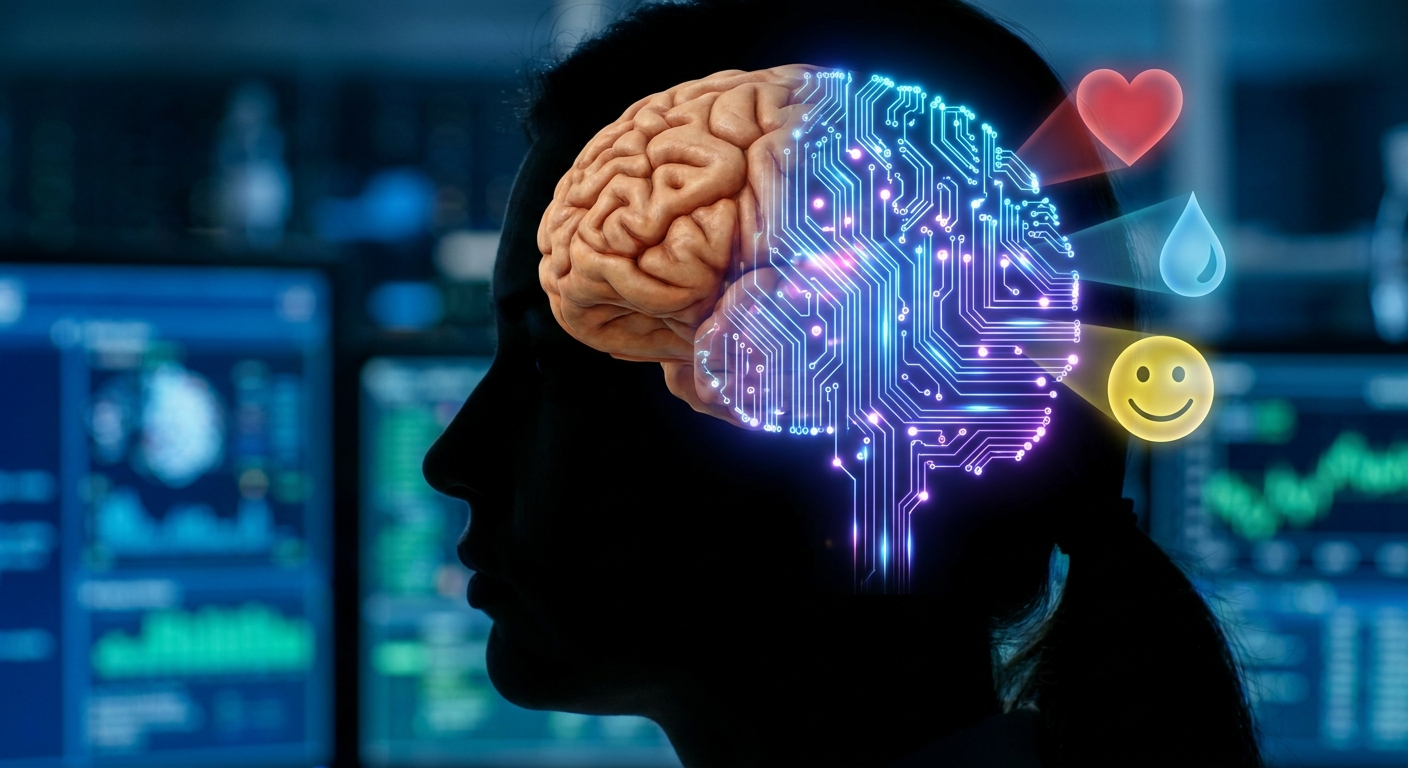
Interoception: your brain listening to your body
Interoception is your brain’s ability to sense internal bodily states—heartbeat, breathing, gut sensations.
Research by Bud Craig and others shows that areas like the insular cortex integrate these bodily signals into emotional experience. For instance:
- People with better heartbeat detection accuracy tend to experience emotions more intensely.
- A 2014 study in PNAS mapped where people felt different emotions in their bodies: anxiety in the chest, sadness in the limbs, etc. These patterns were surprisingly consistent across cultures.
Lisa Feldman Barrett’s constructed emotion theory goes further: emotions aren’t hardwired reflexes but predictions your brain makes about what your body sensations mean in context.
Implication: Changing how you breathe, move, and posture can meaningfully alter how your brain constructs your emotional reality.
4. Memory Is Not a Hard Drive
We often imagine memories as files stored somewhere, ready to be retrieved. Neuroscience suggests something subtler: memory is reconstruction, not playback.
Reconsolidation: memories are rewritten each time you recall them
In classic work with rodents, Karim Nader and colleagues showed that when an existing memory is recalled, it enters a fragile state and can be altered before being stored again. Human studies support this: every time you remember, you edit.
Real-world example:
- Eyewitness testimony is notoriously unreliable. Elizabeth Loftus’s research has shown that subtle suggestions after an event can create vivid but false memories.
This isn’t a design flaw. Memory trades perfect accuracy for flexibility:
- You generalize from past experiences.
- You update memories with new information.
Practical takeaway: The stories you repeatedly tell about your past—both to yourself and others—literally shape what you remember and how you see yourself.
5. Plasticity: Your Brain Is Never Finished
Computers don’t change their own wiring when they run programs. Brains do.
Lifelong rewiring
Neuroplasticity—the brain’s ability to change its structure and function—is not limited to childhood.
Examples:
- London taxi drivers: A famous 2000 study in PNAS found that licensed London cab drivers, who memorize a massive urban map known as “The Knowledge,” had enlarged posterior hippocampi (a structure involved in spatial memory) compared to controls.
- Musicians: Studies show changes in motor and auditory regions of the brain, correlating with years of practice.
- Stroke recovery: Neighboring regions can take over some lost functions with training.
Plasticity has a double edge:
- Good habits physically reinforce helpful neural pathways.
- Chronic stress, rumination, or substance abuse also sculpt the brain.
Counterintuitive insight: Your personality and abilities are more malleable than we like to think—but the brain’s plasticity is guided by what you repeatedly do, feel, and pay attention to.
6. Practical Ways to Work With (Not Against) Your Brain
Understanding that your brain is a predictive, embodied, plastic system leads to concrete strategies.
1. Train your predictions, not just your willpower
Instead of relying on sheer self-control:
- Shape your environment: If your brain predicts “snack when bored at desk,” change the context—move snacks out of sight, add water or tea instead.
- Use implementation intentions: “If it’s 8 pm, then I put my phone in another room.” You’re teaching your brain a new prediction: cue → behavior.
2. Use the body to influence the mind
Because the brain constantly reads bodily signals:
- Slow, deep breathing (especially longer exhales) can reduce sympathetic nervous system arousal.
- Regular exercise boosts neurotrophins like BDNF, which support plasticity and learning.
- Simple posture shifts—standing tall, opening the chest—can alter how threatening or safe your brain predicts the world to be.
3. Treat attention as a limited resource
Computers can multitask without fatigue. Your brain can’t.
Research by Ophir et al. in PNAS showed that heavy media multitaskers perform worse on tasks requiring sustained attention and cognitive control.
Try:
- Single-tasking work blocks (20–50 minutes).
- Turning off non-critical notifications.
- Taking short movement breaks to reset attention.
4. Rewrite yourself deliberately
Given reconsolidation and plasticity:
- Journaling about experiences in a new, more constructive frame can gradually reshape memories and self-concept.
- Therapy often leverages this: you recall painful events in a safer context, with new interpretations, and the memory is stored differently.
7. Rethinking the Metaphor: If Not a Computer, Then What?
No single metaphor is perfect. But some are more aligned with current neuroscience:
- A prediction machine: Constantly modeling what will happen next.
- A social organ: Wired to attune to other brains; loneliness and social rejection light up pain circuits.
- A body-brain system: Cognition emerges from the interaction of brain, body, and environment.
The computer metaphor isn’t useless—but it’s too limited. When we treat our minds as software running on fixed hardware, we underestimate both our vulnerabilities and our capacity to change.
Final Takeaway
Your brain is not a cold calculator. It is a living, guessing, embodied, social organ that rewires itself throughout your life.
If you remember nothing else, remember this: What you repeatedly think, feel, and do is not just “in your head”—it is actively sculpting the physical structure of your brain. And that means the way you design your days is, quite literally, brain surgery in slow motion.